Pages every company website needs
Every company website needs a home page, a page for each service, an about page, a contact page and the legal pages that match the data it collects. A blog, FAQ or case studies are added when you can keep them real and up to date. Each page should have one job and lead the visitor to the next step.
Which pages does every company website need?
The pages every company website needs are a home page, service or product pages, an about page, a contact page and legal pages. Together they answer the three questions every visitor has: what do you do, who are you, and how do I reach you.
Other pages depend on your business. A blog, an FAQ, case studies or a careers page are not required for every company. A page nobody maintains does more harm than good, because it tells visitors the site is not looked after.
The table below sums up the job of each page and when you need it.
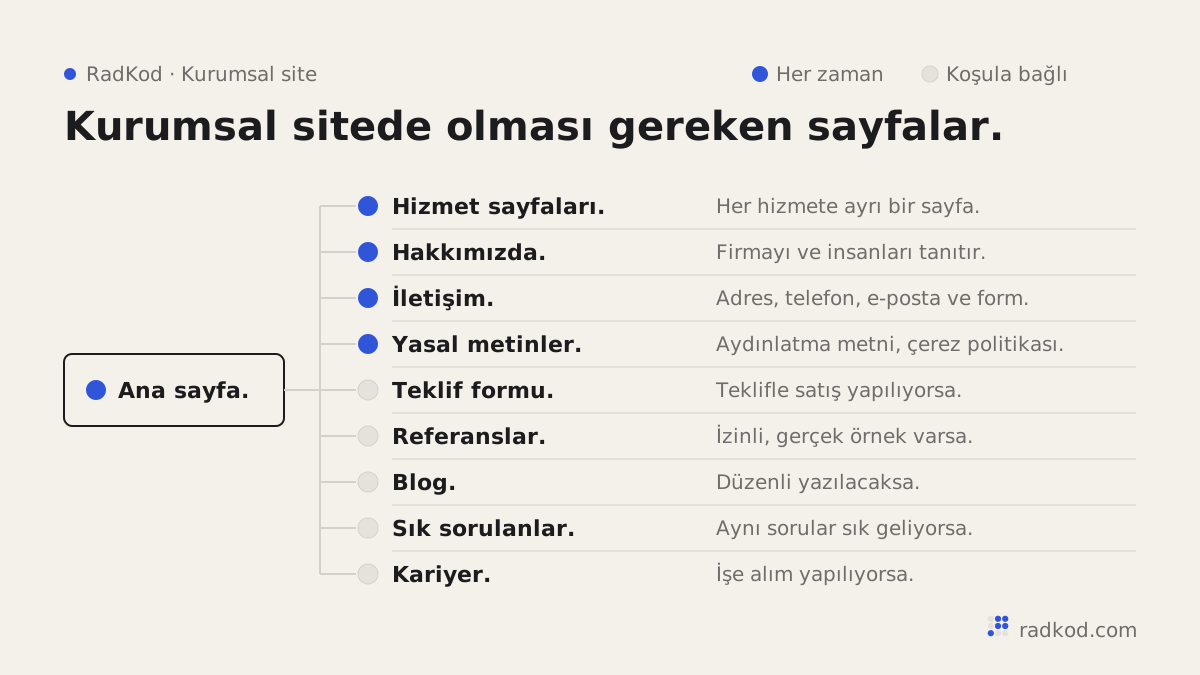
| Page | Its job | When you need it |
|---|---|---|
| Home page | Says what you do at first glance and sends visitors to the right page | Always |
| Service or product pages | Explains each service on its own, so it can be found in search | Always |
| About | Introduces the people and the company, builds trust | Always |
| Contact | Address, phone, email and a short form | Always |
| Privacy notice and cookie policy | Explains how personal data is processed | If you have a form, cookies or analytics |
| Quote request form | Collects enquiries in a structured way | If you sell through quotes |
| Case studies or work | Shows real projects | If you have real examples and permission to show them |
| Blog | Answers customer questions, brings search traffic | If you will publish regularly |
| FAQ | Collects repeated questions in one place | If the same questions keep coming |
| Careers | Lists open roles and how you work | If you are hiring |
What should the home page include?
The home page should say what you do in one plain sentence on the first screen and send visitors to the right page. A plain sentence beats a slogan. "We install industrial cooling systems in western Turkey" tells a visitor far more than "building the future together".
- A headline and a short description of what you do.
- A short list of services, each linked to its own page.
- Three or four concrete reasons to work with you.
- A clear call to action: request a quote, call or write.
Why should each service have its own page?
Each service needs its own page because people search for one service at a time, and search engines favour a page that covers one topic well. Listing five services on one page usually means all five rank poorly.
A good service page answers five things: what the service is, who it suits, how the process works, what is delivered and what the next step is. Our own web design page follows this structure. For the search side of it, see what makes a website SEO friendly.
What should an about page say?
An about page should show the people behind the company and how they work. A founding year and a mission statement do not build trust on their own. Names, faces, who does what and concrete working rules do.
On our about page we introduce the three partners and the rules we hold ourselves to. The aim is simple: a visitor should know who they will talk to before they write.
What makes a good contact page?
A good contact page lets visitors reach you with the least effort. A phone number, an email address, a postal address and a short form are enough. Every extra form field lowers the number of people who send it.
It also helps to say how quickly you reply. We reply within one business day and say so on the page. If you serve clients in other countries, add your time zone and the languages you work in.
Which legal pages does a company website need?
If your site collects personal data, for example through a contact form or analytics that use cookies, you need a privacy notice. Cookies usually also need a cookie policy and, depending on the law, a consent banner.
Which rules apply depends on where you and your visitors are. A company in Turkey falls under KVKK, the Turkish data protection law. Visitors in the EU bring GDPR into the picture. The text itself is a legal matter, so ask your legal adviser to review it. We build the technical side: the notice under each form, the cookie consent and the pages. Our KVKK compliant website guide lists those technical steps.
Do you need a blog and an FAQ page?
A blog and an FAQ are not required, but they are the best place to answer the questions your customers already ask. Each answered question can bring visitors from search.
What matters is consistency. A single post from two years ago tells visitors the site is not current. If you cannot write regularly, starting with an FAQ page is often the better choice.
How should the menu be ordered?
Order the menu by what visitors look for most. On most company sites that means services, about, blog and contact.
Fewer menu items make decisions easier. Five or six top-level items are usually enough. If you have many services, use a dropdown under Services. Legal pages and careers belong in the footer, not the main menu.
Use plain labels. "Services" works better than "Solutions", and "Contact" works better than "Get in touch". Plain labels help visitors find things faster and help search engines understand the structure of your site.
What should every page have in common?
Every page should have a clear call to the next step and basic contact details. A footer with your address, phone and links to the legal pages covers most of it.
- A layout that works on phones. This is called responsive design.
- A unique title and description for each page.
- Descriptive alt text on images.
- Readable font sizes and enough colour contrast.
Once the page list is ready, the next step is the build itself. The process is covered in how to get a website built, and the cost factors in what determines the cost of a website.
Frequently asked questions
Is a one-page company website enough?
It can be for a company with very few services that does not expect search traffic. If you offer more than one service, a separate page for each usually works better.
Can I show client logos on a references page?
Only with your client's permission. Do not use a logo or project name without it.
Who writes the privacy notice?
The content depends on how your company processes data, so it is a legal matter. A lawyer usually drafts it, and we place it correctly on the site.
Who should write the blog posts?
The person who knows the work best. An editor can polish the text, but the knowledge has to come from you.
How many pages should a company website have?
There is no fixed number, but the core set is a home page, one page per service, about, contact and legal pages. For a company with five services that is often around ten pages. A blog and FAQ are added as needed.
Do people actually read the about page?
Yes, especially just before they ask for a quote. Visitors want to see who they will work with. Names, photos and concrete working rules build more trust than a founding year.
Should the contact page include a map?
Yes, if clients visit your office or shop, because it helps with directions. If you do not receive visitors, a clear address and phone number are enough. If you add a map, load it in a way that does not slow the page down.
Does every website need a cookie policy?
If the site uses analytics, advertising or similar cookies, you need a cookie policy and often a consent banner. Which cookies need consent is a legal question that depends on where you operate. Ask your legal adviser for the details.
Sources
- 01 Kişisel Verileri Koruma Kurumu · KVKK
- 02 WCAG 2 Overview · W3C Web Accessibility Initiative
- 03 SEO Starter Guide: The Basics · Google Search Central